ABOUT MOTHERLAND
What is MOTHERLAND?
MOTHERLAND is a non-profit that works with smallholder farmers in Siaya County, Western Kenya: we cut post-harvest loss, rebuild living soil and secure fair prices. In Germany the legal entity is Learning from the Motherland gUG (haftungsbeschränkt), founded in Hamburg in 2023 and recognised as a charity. On the ground, our partner organisation MOTHERLAND CBO leads the work, a community based organisation in Siaya County. Today more than 2,000 farmers are part of the network.
Where does MOTHERLAND work?
In Siaya County in Western Kenya, close to Lake Victoria. In 2025 we were active in five communities: Pap Gori, Malanga, Boro, Yala and North Alego. In Siaya we prove that the model works. It can be carried anywhere farmers face the same barriers.
Who is behind MOTHERLAND?
Diana Beata Krüger, Sebastian Fittko and Thomas Schindler founded the organisation in 2023, after more than six months of conversations with over 50 African entrepreneurs and experts. Diana runs Learning from the Motherland gUG as managing director. In Kenya, MOTHERLAND CBO leads the work, with Catherine Sylvester Awuor as CEO and Violet Atieno as Head of Monitoring, Evaluation & Learning. Meet the team →
How do Learning from the Motherland gUG and MOTHERLAND CBO work together?
MOTHERLAND CBO is an independent community based organisation in Siaya County. It runs the work in the field together with the farmers. Learning from the Motherland gUG in Hamburg raises funds, builds technology and partnerships and reports to funders. In Germany we deliberately stay lean: every new position is created in Kenya.
THE PROBLEM
What is post-harvest loss?
Post-harvest loss is food that is lost between field and market: damaged at harvest, poorly dried, attacked by pests or mould in storage, spoiled in transport or sold far below its value because a family needs cash right after the harvest. The FAO estimates that in sub-Saharan Africa up to 37 % of food is lost between production and consumption (FAO, 2011). For Kenya, a 2025 study by WRI Africa, FOLU Kenya and JKUAT puts losses for maize at 20 to 36 %, most of it in storage (about the study).
Why does MOTHERLAND focus on what happens after the harvest?
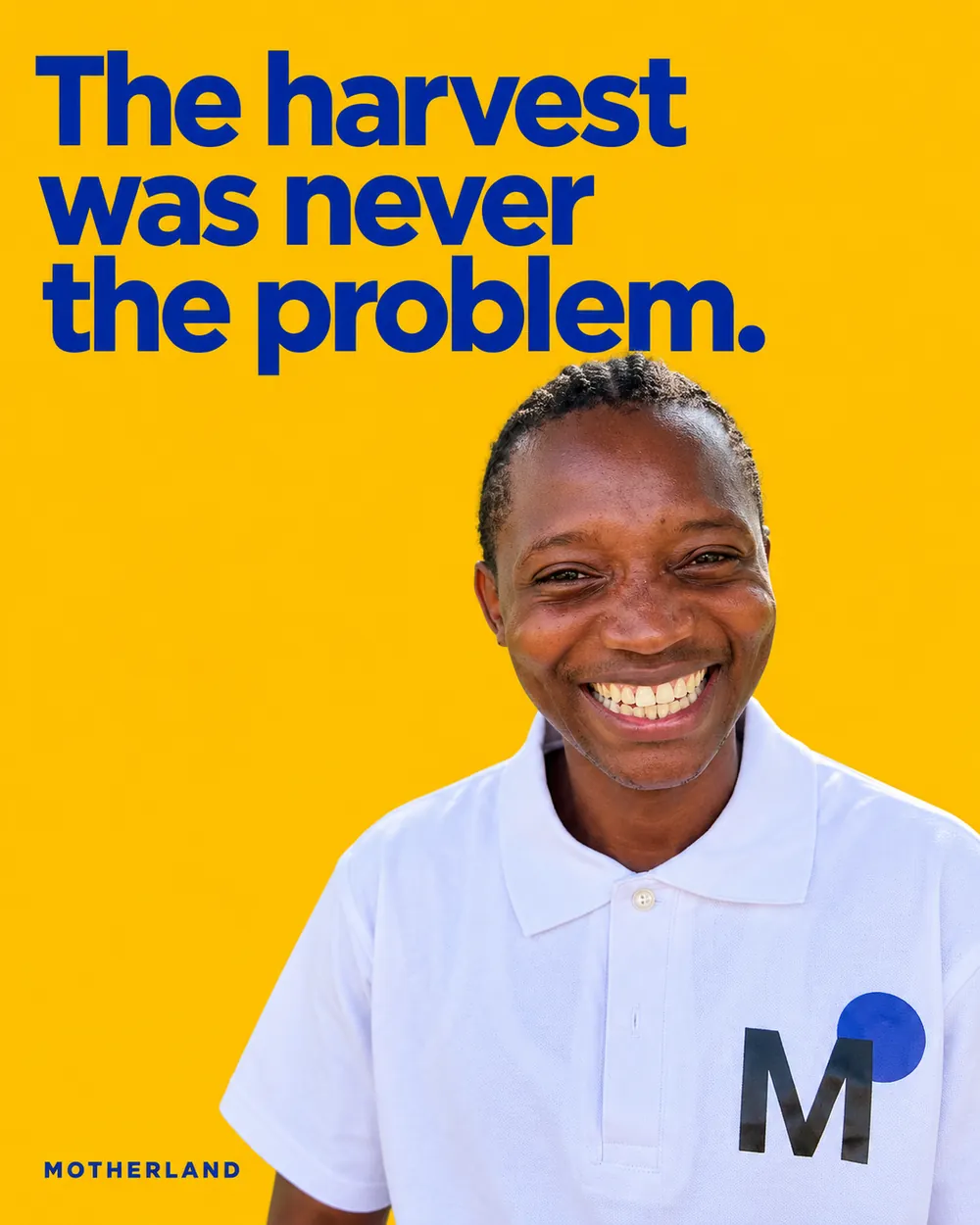
Because a good harvest alone leaves nobody better off. If a farmer cannot dry and store her harvest and has no transport and no reliable buyers, she has to sell on the day she needs money, at any price. Post-harvest loss is not a storage problem. It is a system problem: handling, drying, storage, transport, buyers and price all have to work together.
HOW WE WORK
How does MOTHERLAND cut post-harvest loss?
Together with the farmers we build the whole chain, link by link: living soil, certified seed on loan, training on harvest timing, drying and sorting, joint collection and airtight storage, transport and committed buyers. If one link is missing, the value is lost. How we work →
How do farmers get a fair price?
Through Nyota Beans, our bean value chain. Farmers know their price before they plant: MOTHERLAND buys at a fixed price, in 2025 that was 67% more per kilo than they used to get on the open market. We collect, store and sell directly to buyers. So nobody has to sell under pressure after the harvest.
How do seed loans and the seed bank work?
Farmers receive certified seed on loan and repay it with part of their harvest. That becomes the seed for the next season. In 2025, 72.1 % of loans were repaid. Our first 3 acres of seed multiplication produced 1,390.5 kg of KEPHIS-certified Nyota seed, and the area is now growing from 20 to 100 acres.
What does regenerative agriculture mean at MOTHERLAND?
It starts with living soil: compost, organic fertiliser and methods that build the soil up instead of wearing it out. Healthy soil holds water and carbon and gives higher yields. Lead farmer Liz Akinyi raised her bean harvest from about 30 kg to 100 to 120 kg per acre. Our rule: regeneration has to pay off for the farmer, not only for the soil.
What is Lima AI?
Lima is our AI farming advisor on WhatsApp. It answers around the clock in English, Swahili and Dholuo, the language spoken in Siaya, based on verified agricultural content. It also offers market prices, soil and weather information and a course with 16 modules. Lima is built with PeachStone AI and funded by the Cisco Foundation. Our goal: 12,000 farmers on Lima by 2027.
Who are the Young Earth Guardians?
Young Earth Guardians is our work with the next generation. In school gardens in Siaya County, children learn regenerative farming as something that works, pays and heals the soil, while they watch their parents get a fair price. More about Young Earth Guardians →
IMPACT
What has MOTHERLAND achieved so far?
In 2025 we counted 517 farmer participations in five communities, 78.3 % of them women. They harvested 8,946 kg of beans, and 83.7 % of 141 farmers surveyed report a higher income. Through our market, farmers get 67% more per kilo of beans. All figures are documented in our Impact Report 2025.
How does MOTHERLAND measure impact?
Everything runs through one digital system: registration, seed loans, harvest and payouts via M-Pesa. We record more than 70 data points per farmer, from soil and planting to losses and income. That way every sack and every shilling can be traced. Violet Atieno, our Head of Monitoring, Evaluation & Learning in Kenya, leads this work. We measure what changes for farmers, not how many trainings we gave.
What are MOTHERLAND's goals?
More than 15,000 farmers by 2031 and 25,000 by 2035, with post-harvest loss of 10 % at most and 50 % more income. Our Strategy 2026–2031 →
SUPPORT
How can I support MOTHERLAND?
You move the most with 200 for MOTHERLAND: 200 people give €50 a month, together €10,000 a month for the whole system. Once a month you meet the team from Siaya in the Circle call, and every three months you get an honest report. You can also give once or partner with us as a company or foundation. Become one of 200 →
Is my donation tax-deductible?
In Germany, yes. Learning from the Motherland gUG is recognised as a charity by the German tax office. Donations are made through Bcause, and you receive your donation receipt directly from there.
What is my donation used for?
For what project grants rarely pay for: the Local Impact Teams in Siaya, Lima AI, monitoring and the organisation that holds it all together. Monthly donations are unrestricted and go where they are needed most. Our budget for 2026 is €230,000, of which €190,000 is secured.
Can I stop my monthly donation at any time?
Yes. You can stop or pause your monthly donation at any time. If you need help, write to diana@motherland.earth.
How do I know MOTHERLAND is trustworthy?
We have signed the self-commitment of the Initiative Transparente Zivilgesellschaft (Transparent Civil Society Initiative) and disclose who we are, where our money comes from and what we spend it on. Our work was audited through our cooperation with GIZ, our accounts are prepared with a tax advisor, and our tax exemption notice, articles of association and impact reports are public. Transparency & reports →
Who are MOTHERLAND's partners?
Among others GIZ, SAIS, KALRO, KEPHIS, the W.P. Schmitz Stiftung, the Cisco Foundation, the Chancemaker Foundation, Biovision, PeachStone AI, Rhea Soil Health, eProd Solutions, Duhqa and KOAN. Companies and foundations that want to work with us can write to diana@motherland.earth.
How do I stay up to date?
With our newsletter: news from Siaya and honest updates straight to your inbox, unsubscribe anytime with one click. Go to the newsletter → Longer stories from the field, including what goes wrong, are told by Diana and the team in our blog. blog.motherland.earth →